11 January 2026, 32-minute read
Preparing Young Designers for the Future of Industry
During my industry placement at Sevenoaks School, I was tasked with writing a placement dissertation on a topic of mutual interest. This assignment was set by the tutors at my supervising university and proved to be an interesting delve into looking at various cutting-edge technologies and their potential implications on what we should be teaching young designers today.
With a few years' mor perspective, my views on this dissertation have drifted somewhat from those expressed in the conclusion. In short, my stance is less prescriptive: given the increasing pace of technological advance and the heightened volatility of the new political world order, it could be considered futile to even try and predict what technologies will be predominant or cutting-edge in industry by the time students find themselves in the workforce. Thus, a more skills-based approach to teaching would be advisable; we ought to arm students with the tools to navigate such a changeable and volatile future independently. I might explore what that possibly looks like in a future post; for now, I hope you find this article (and its many errors) useful!
Advancing D&T Education: Preparing Young Designers for the Future of Industry
Yuvraj Sethia
August 2023
Diploma in Placement Studies
Loughborough Design School
Table of Contents
I. Introduction
I.I Background of Industrial Design
I.II Significance of Adapting Education to Meet Future Needs
I.III Aim and bjectives of the Dissertation
I.III.I Evolution of Industrial Design
II. Literature Review
II.I Current State of Secondary Design & Technology Education
II.I.I Design & Technology KS3 Curriculum
II.I.II Product Design GCSE and GCE A-Level Curricula
II.II The Influence of Technology
II.III Influence Of AI And Machine Learning
II.III.I The Evolution of Manufacturing
II.III.II Opportunities Presented by Additive Manufacturing (AM)
II.III.III Additive Manufacture in a 4IR Future: Distributed Manufacture
II.IV Democratised Design and Manufacture
II.V Sustainability And Eco-Design Considerations
II.V.I Right to Repair
II.V.II Design for Repair (DfR)
III. Discussion of Future Trends in Industrial Design
III.I Opportunities Presented by 4IR Manufacturing Systems
III.I.I Digital Twins
III.I.II Data-Driven Design and Validation
III.I.III Designing for Personalisation
III.I.IV Distributed Manufacture
III.II Democratised Design and Cosmolocalism
III.II.I Cosmolocal Design Projects and The Role of Open-Source Contribution
III.III Design for Repair and Circular Design
IV. Recommendations For Adapting Secondary Design & Technology Education
IV.I Breaking Down the Walled Garden of Classroom Design Practice
IV.II Can You Fix It? Design for Repairability
IV.III Implementing Changes for 4IR
IV.III.I DfAM and Large-Scale AM Production
IV.III.II Other Opportunities
Iv.IV Teamwork, Cosmolocalism, and Open-Source Development Micro-Communities in a School Context
V. Conclusion
V.I Recap Of the Dissertation's Insights and Its Importance
V.II Suggestions for Further Reading
V.III Vision For the Future of Industrial Design and Education
VI. Table of Figures
VII. Appendices
VII.I Chatbot Interview with OpenAI GPT-4
VIII. References
I. Introduction
I.I Background of Industrial Design
Industrial design is defined as the professional practice of designing products, devices, objects, and services used by millions of people around the world every day (Industrial Designers Society of America, 2023). The process through which design solutions are found is known as design thinking. It is a discipline with applications wide and diverse, and new uses for design thinking are constantly being found (Köppen, 2021).
I.II Significance of Adapting Education to Meet Future Needs
Educating young people on the transformative power of design is among the most effective methods of sparking inspiration and fuelling young designers to actively partake in the field. It is exposure to technology, innovation, and new thinking that will be responsible for shaping the designers of the future, and thus the products of the future. In the UK, this exposure comes primarily in the subject of design and technology (commonly referred to as D&T or simply, DT).
As the projected image of the future evolves in line with new discoveries and emerging technologies, it is critical that D&T education keeps up and changes to reflect the needs of students.
Improving today’s D&T curriculum is the chance to prepare young designers for the challenges and opportunities they will face in tomorrow’s world.
I.III Aim And Objectives of The Dissertation
This dissertation will look at transformative technologies and growth drivers that are presently in their infancy. Inferences will be made, and areas of focus and growth will be identified to help ‘paint a picture’ of possible future scenarios.
Activities and methods for improving education with the aim of better preparing young designers for this future will be explored and evaluated.
While this dissertation focuses on the English secondary curricula, findings may be relevant in other countries, especially others in Britain.
I.III.I Evolution Of Industrial Design
Industrial design is constantly evolving to meet new or unmet user needs, respond to societal change, and exploit new technologies. It is reasonable to expect this evolution to continue as it is core to the discipline. All these aspects will be explored to inform the vision for the landscape in the near future.
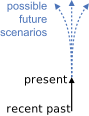
Figure I.a: Informed extrapolation process
II. Literature Review
II.I Current State of Secondary Design & Technology Education
II.I.I Design & Technology KS3 Curriculum
Product Design as a discipline is taught at different levels. It is commonly taught in secondary education before students choose or study specialised subjects.
The national curriculum specifies a range of skills and knowledge that should be imparted to students in service of four key aims:
"Aims
The national curriculum for design and technology aims to ensure that all pupils:
• develop the creative, technical and practical expertise needed to perform everyday tasks confidently and to participate successfully in an increasingly technological world
• build and apply a repertoire of knowledge, understanding and skills in order to design and make high-quality prototypes and products for a wide range of users
• critique, evaluate and test their ideas and products and the work of others
• understand and apply the principles of nutrition and learn how to cook”
Figure II.a: Department of Education aims for designand technology national curriculum (Department for Education, 2013). This covers KS1, KS2, and KS3.
At a high level, these aims seem noble, realistic, and well-rounded. Their implementation at KS3 leaves room for educators to customise delivery – often to tailor to the strengths of the teaching faculty and the equipment available.
It appears that classrooms are still focused on imparting skills and building familiarity with tools that can be quite alien to students upon first impression. Nicholl, et al. (2012) found that tasks planned by teachers for students did not provide opportunities to identify users' needs when solving design problems. Tasks were centred around designing “routine products” (p. 931): bags or pencil cases often with pre-cut materials. The report outlines how teachers incorporated terminology such as ‘user’, ‘market’, or ‘client’, however failed to back those terms up with an authentic product design experience. It is intuitive how this disconnect could lead to a broken understanding of the actual meaning of these terms.
Nicholl, et al. (2012) further criticises the sandboxed nature of DT education, linking back to writing by John Dewey:
“it is a mistake to suppose that acquisition of skills in reading and figuring will automatically constitute preparation for their right and effective use under conditions very unlike those in which they were acquired.”
Figure II.b: Dewey on the topic of preparation in education. (Dewey, 1938)
II.I.II Product Design GCSE and GCE A-Level Curricula
When reviewing comments about GCSE design and technology coursework Owen-Jackson (2003) highlights a ‘lack of flair’ (Owen-Jackson, 2003, p. 29). The GCSE and A-Level specifications offered by exam boards detail a similar mix of materials, manufacturing processes, and design theory/practice (AQA Education, 2022a) (AQA Education, 2022b) (Pearson Edexcel, 2022a) (Person Edexcel, 2022b). The content is filled with fundamentals and essentials for any aspiring designer, for example: different types of timber and their stock forms (AQA Education, 2022a, p. 13).
Forward-looking content is included in certain sections and appears to be a greater focus for certain exam boards than others (Person Edexcel, 2022b, p. 9).
II.I.II.A Shortcomings of KS4 and KS5 Curricula
Notably, there is a lack of explicit design methodology, such as user observation or prototype evaluation methods. This appears to be left to teachers to deliver to students. There is also no teamwork aspect at KS4 and KS5 – an issue the officials are apparently aware of (Barlex, 1998, p. 252) but still remains unremedied.
II.II The Influence of Technology
II.III Influence Of AI And Machine Learning
The opportunity for LLMs to simulate user personae is one with pros and cons, the implications of which are currently unknown. In primary testing, an LLM was used to generate a user persona and conduct a user interview for insight. It’s effectiveness as a design tool is difficult to establish as it requires comparison to known useful real-world user personae, interviews, and subsequent specifications.
Due to the infancy of such technologies as viable solutions, there does not appear to be significant gain from exploring them at the time of writing. Their use is controversial, and speculation of future uses based on current early technology would not be particularly reliable.
Nevertheless, the interview, conducted with OpenAI GPT-4 through its chatbot interface is available in Appendix VII.I Chatbot Interview with OpenAI GPT-4.
II.III.I The Evolution of Manufacturing
The world has thus far seen three complete industrial revolutions: the first being the mechanisation of previously hand-based manufacturing, the second characterised by rapid scientific development and electrification, and the most recent, ‘third industrial revolution’ being the integration of digital computers in the manufacturing equipment.
It is proposed that another industrial revolution is underway and projected to accelerate (Lorenz, 2015). Commonly referred to as the ‘fourth industrial revolution’, or simply 4IR, it is expected to significantly reshape the manufacturing landscape.
4IR is characterised by the implementation and integration of four types of disruptive technologies in the manufacturing pipeline:
“Connectivity, data, and computational power: cloud technology, the Internet, blockchain, sensors
Analytics and intelligence: advanced analytics, machine learning, artificial intelligence
Human–machine interaction: virtual reality (VR) and augmented reality (AR), robotics and automation, autonomous guided vehicles
Advanced engineering: additive manufacturing (such as, 3-D printing), renewable energy, nanoparticles”
Figure II.c: The four types of characterising technology of the fourth industrial revolution. (McKinsey & Company, 2022).
The deployment of these technologies has demonstrated unforeseen benefits, often compounded by a synergistic approach to using these technologies.
II.III.I.A Digital Twins
Companies can create a virtual software model of the manufacturing floor, commonly referred to as a digital twin. The digital twin can be manipulated and copied to create different variations of a proposed change (Brosset, et al., 2022). The feasibility of restructuring a manufacturing pipeline to accommodate a new production procedure for a new product can be assessed without any effects on the operation of the operation of the manufacturing plant. Integration of new machinery and workstations can be ‘soft’ tested before ever being implemented physically.
II.III.I.B Machine Intelligence through Data Collection
Integrated smart systems allow for the collection of data on machine operation, performance, and wear. This field is referred to as prognostics and health management. Current-generation hardware can use advanced algorithms to determine machine health, however next-generation 4IR manufacturing systems use machine learning and artificial intelligence to assist with predictive maintenance (Çınar, et al., 2020). Predictive maintenance facilitates the early diagnosis and prevention of manufacturing problems, improving manufacturing reliability, reducing machine downtime, and lowering maintenance costs.
II.III.I.C Big Data-Enabled Connected Intelligence and Operational Analytics
Since every component can be fitted with connected sensors, the quantity, granularity, and quality of data collected is far greater in 4IR manufacturing systems. Centralised collection and storage of data is enabled by the connection each component of the pipeline maintains to a central server. As well as enabling a level of connected ‘intelligence’ that is characteristic of 4IR, data from various sources can be combined and analysed to provide a better-rounded understanding of the operation of product manufacturing.
Among the insights that may be possible to generate from this data analysis is the specific cost and return on investment (ROI) of minute design changes. Small tweaks in design can be tested and validated with accurate data on cost-effectiveness (Brosset, et al., 2022).
II.III.I.D Augmented Reality and Personalisation
Augmented reality (AR) implemented in manufacturing pipelines has the potential to dramatically change the human workforce requirements and lower the barrier to entry for stages of manufacturing that traditionally required skilled workers (Brosset, et al., 2022).
More relevant to the field of industrial design, however, is the opportunity for customisation. A hand-tooling technician wearing AR assistance could receive personalised instructions for customising a part from a central database. The AR wearable could recognise the product in front of the technician and overlay a customer-personalised design or aid.
While a part mould is difficult to individualise, 4IR manufacturing systems could track a product as it passes through the pipeline and certain other computer-aided manufacturing (CAM) machines, connected to a central database, could personalise the process applied to the product or part (Automation Alley, 2019).
For example, a user could upload a photo or graphic to the product website when ordering. This could be converted to a CNC engraving toolpath using AI-enabled depth extrapolation. In the manufacturing plant, a connected CNC engraving machine could identify the personalised order when passed to it, pull the customised toolpath from the company server, and engrave the product with the custom design.
II.III.II Opportunities Presented by Additive Manufacturing (AM)
Additive manufacturing technologies allow designers to directly translate virtual solid model data into physical models in an automated manner. It is among few manufacturing processes that is what you see is what you build (WYSIWYB) and is especially valuable for complex geometry (Gibson, et al., 2021, p. v).
Previously impossible designs can be realised with additive manufacturing (Bentz, 2023) and new levels of efficiency can be achieved since parts can be optimised to print with no waste.
II.III.II.A 4D Printing
Gibson, et al. (2021) introduces the idea of 3D-printed parts that change form over time in response to an environment variable changing, such as temperature, moisture, or pH. Such printed parts are referred to as 4D-printed parts, where the fourth dimension is time. Breakthroughs are being made currently in this field and novel applications for 4D-printed parts are being explored with new ones yet to be discovered.
4D-printed arterial stents were designed and manufactured through a new AM process to solve existing problems faced by surgeons and patients (Hendrixson, 2020). This is one example of transformative new synergies between design, manufacturing technology, and material science.
II.III.III Additive Manufacture in a 4IR Future: Distributed Manufacture
The combination of AM and connected, smart CAM presents an interesting opportunity: smaller-scale yet mass-manufacturing style production plants scattered geographically such that no plant is very far from an end consumer. AM lends itself to customisation, so there would be no compromise on product SKU and variant diversity offered to customers, but there would be a reduced need for keeping stock in warehouses or transporting from a central manufacturing plant.
This concept is referred to be professionals as distributed manufacturing and is enabled by the general scale-independence of AM costs and feasibility. AM plants are a proven concept now and rivalling traditional moulding systems for small-to-medium scale deployment with some key benefits:
• Reduced shipping
• Eliminated warehousing needs
• No tooling required
• No minimum order quantity
Figure II.d: Benefits of Distributed AM plants. (Slant 3D, 2023)
II.IV Democratised Design and Manufacture
Kostakis & Ramos (2017) details the story of a community in France exploiting design tools available and rudimentary distributed manufacturing including AM to design and manufacture a product that solves problems faced by small-scale farmers. The designs are not-for-profit and open-sourced. The model was described as “design global, manufacture local” (Kostakis & Ramos, 2017) and is characterised by the global distribution of “what is light (knowledge, design)”: and the local production of “what is heavy (manufacturing)”. Such a model of product design and manufacture is perfectly suited to distributed manufacturing.
It is noted that there are reasons this model is cost-effective, too.
“The profit motive is not totally absent, but it is peripheral.”
Figure II.e: A comment on the cost feasibility of democratised design and manufacture. (Kostakis & Ramos, 2017)
This model is not limited to the agricultural industry: the Wikihouse and RepRap communities are two more examples outlined in the article. “Cosmolocalism” (Kostakis & Ramos, 2017) is a term used in the article to describe a globally responsible, compassionate, and community-driven approach to problem-solving is a refreshing alternative to operational model of multinational corporations and government intervention.
II.V Sustainability And Eco-Design Considerations
Conscientious use of resources, sustainable manufacturing and use, and low environmental impact-design are at the forefront of societal conversation regarding product design and consumption. It is important, now more than ever, to both companies and consumers to minimise the environmental impact and ensure processes and lifestyles going forward are sustainable in the long term.
II.V.I Right to Repair
One aspect of product design gaining media attention and traction in everyday life is repairability and ownership. Consumer are becoming increasingly aware of the lack of options when products reach the point of failure, typically only two: manufacturer (first-party) repair or the purchase of a new product to replace the old one (Speight, 2023). Those who self-attempt repair are faced with a slew of obstacles, some seemingly artificially placed, to prevent successful repair despite adhering to best practices (Jeffreys, 2023).
A movement aiming to reduce the cost of repair, increase availability of choice for repair, reduce product waste and landfill, and hold corporations and manufacturers to higher standards for supporting third-party repair was founded. Commonly referred to as the Right to Repair movement, it seeks to enforce alternatives to practices considered ‘anti-consumer’:
• Software locks forcing users to buy first-party accessories/ components (for example, manufacturer inkjet cartridges over generic cartridges (Cavendish, 2023)).
• Proprietary fasteners and irreversible/one-time-use fixings (for example, ‘pentalobe security screws’ (Cox, 2011) or the use of adhesives to hold a product together (Hernandez, et al., 2020)).
• Manufacturer monopolies on repair – sometimes caused by the unavailability of repair manuals and schematics.
• Designing products for planned obsolescence
• Lack of access to affordable, quality replacement parts
• High levels of post-purchase company control enabled by smart products (Tusikov, 2019) (Jeffreys, 2022) (for example, the disabling of printers if an ink subscription is stopped (Warzel, 2023)).
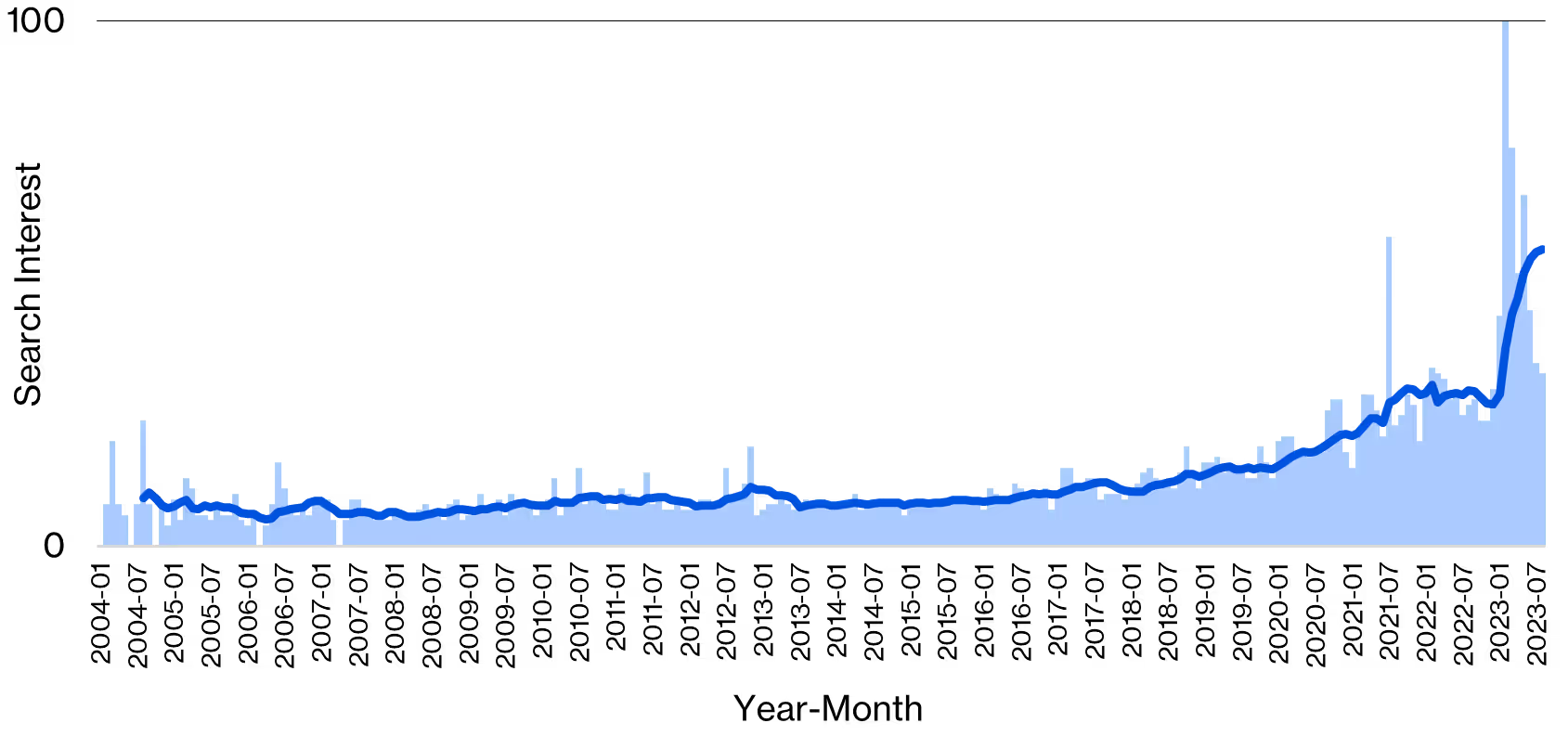
Figure II.f: Worldwide Google search interest for ‘right to repair’ over time. Search interest is relative to highest level of interest. Data from Google (Google Trends, 2023) shown by light shaded bars. 8-point moving average trendline superimposed to display overall trend.
Its proponents have made headway and is now in the process of convincing lawmakers to pass legislation seeking to enforce higher standards for designers, manufacturers, and businesses (Svensson, et al., 2018). Large corporations – previously resisting the movement – have also expressed interest in expedited passing of such legislation (Brodsky, 2023). Kyle Wiens, CEO of repair advocate and online source iFixit, commented on the situation:
"It feels like the Berlin Wall of tech repair monopolies is starting to crumble, brick by brick."
Figure II.g: Comment from Kyle Wiens, CEO of iFixit (Claburn, 2023).
The model legislative template (The Repair Association, 2023) outlines some key policy objectives, among which is the requirement for the product development process to implement ‘design for repair’ principles (Baker, 2023). Among other key objectives, this one has particularly heavy implications for designers which are discussed below (see III.I.IV). Proposed legislation in the EU also takes on this proactive approach to encouraging repair by enforcing repairability be designed into the product from conception (Perzanowski, 2021, p. 389). The Indian government has also made headway by proposing a law requiring OEMs to release schematics and documentation publicly in aid of repair (The Times of India, 2022).
II.V.II Design for Repair (DfR)
There does not seem to be a great body of published research on this topic in the academic domain. This may be because the field of research is very young: only being extremely important in recent years. Other reasons may be that designers are already armed with excellent tools informing them on how to design for repairability – primarily their understanding of assembly and component choices. The few sources available are discussed in this review and later, in Discussion of Future Trends in Industrial Design (see III.I.IV).
Designers should design flexible and adaptable products that facilitate ease of repair in a variety of scenarios (Rosner & Ames, 2014). Products fail in many ways through organic use and it is not possible for designers to predict or ‘script’ at the point of design how these breakdowns or repairs will occur.
In their article, Rosner & Ames (2014) go on to further detail other insights valuable for designers – specifically how certain types of repair may be taken on by a particular gender of people more than another (Rosner & Ames, 2014, p. 326). Designers can play a role in reducing the jarring nature of repair for all and, in turn, reduce the “gendered divisions of labour” (Rosner & Ames, 2014, p. 326).
Designers should also be aware that the lifespan of a product cannot be determined in isolation but is also dependent on its interaction with other products in its use environemtn. Repair also depends on the user’s familiarity with other products and their history of repair. The interplay between these various factors that affect ease of repair and its result on the product lifespan pre- and post-repair is referred to as negotiated endurance (Rosner & Ames, 2014, p. 329).
III. Discussion of Future Trends in Industrial Design
III.I Opportunities Presented by 4IR Manufacturing Systems
III.I.I Digital Twins
Digital twins have an interesting implication on the pace of the industrial design process. Reducing the monetary and time cost of updating the manufacturing pipeline may lead to a future of accelerated design iteration. In this scenario, designers may be incentivised to finalise generational revisions to designs following a quicker schedule permitted by the lower cost of manufacturing updates. Material and technology improvements may be prioritised over aesthetic/form updates as there would be no impact on the pace of cyclical visual trends. The integration and overlap between design and engineering may be augmented as a result.
Product development may also shift from primarily cyclical to continuous; digital twins can enable smaller, more frequent changes to product manufacturing which would be best exploited by a continuous product development schedule. Generational updates would be eschewed in favour of frequent, incremental updates. Incremental product updates are already commonplace in certain industries; some SSD manufacturers, for example, continually update key components on their drives (Webster, n.d.) for various reasons including market forces and availability.
III.I.II Data-Driven Design and Validation
4IR manufacturing systems may unlock a higher propensity for risk-taking in product design. Armed with the ability to objectively evaluate the business success and ROI of riskier or costlier design decisions (simply texturing a hard ABS handle versus adding an over-moulded elastomer grip), companies may approve the probationary implementation of such designs. In such a situation, designers will be bestowed a new level of liberty: full-scale manufacturing implementation of higher-risk designs for validation. This freedom goes hand-in-hand with the above-mentioned model of continuous change to a product’s design facilitated by digital twins (III.I.I).
III.I.III Designing for Personalisation
Augmented reality and 4IR manufacturing systems permit efficiently manufactured but heavily customisable product design. There is an opportunity to move away from one-size-fits-most design to mass-manufactured yet tailor-made products. Traditional wisdom and best practices for inclusive design and ergonomics, while still likely to be relevant for a large number of design decisions, may need supplementing with new learnings from the personalisation permitted with 4IR connected manufacturing systems.
III.I.IV Distributed Manufacture
The possibilities that distributed manufacturing may unlock can only be realised when paired with design principles that better-suit part geometry for additive manufacture: commonly known as design for additive manufacture (DfAM).
A future where repair parts can be manufactured in the customer’s local area on-demand from CAM code stored in a centralised cloud library is not far-fetched and would be aligned with global right-to-repair efforts. This might mean a large number of parts within assemblies need to be designed for affinity with mass-manufacturing AM plants. The education implications of this would be an increased focus on DfAM – especially large-scale automated AM.
Smaller companies with more variable product manufacturing or made-to-order models could be more likely to opt for AM production plants, bolstering the importance of DfAM principles in the classroom.
III.II Democratised Design and Cosmolocalism
III.II.I Cosmolocal Design Projects and The Role of Open-Source Contribution
If cosmolocalism (Kostakis & Ramos, 2017) rises in prominence in the global design landscape, designers’ contributions to open-source community projects could see increased importance placed on them. This may not be dissimilar to how open-source contributions are viewed in the software development industry.
III.II.I.A Open-Source Contribution as a Professional in Software Development
Open-source contribution carries significant weight in software development interviews and job applicants are encouraged to have a well-rounded development portfolio/online profile (such as on online development platform, GitHub). Figure III.a illustrates attitudes towards open-source software development contributions in a Quora answer.
“While not necessary for a developer’s career, some things that contribution to open source projects demonstrates are:
• That you have technical interests outside of your work day that are important enough to you to be actively involved in them.
• That you are seeking to contribute your expertise in an area outside of work.
• That you are invested in the open source tools you (will) use as part of the job. (For example, if you are seeking a job at Red Hat, but do not have any history of contribution to any open source project, it might raise an eyebrow. It might raise less of one if you are working with proprietary tools at an agency. This is because knowing and understanding the community around an open source project, and even having relationships with its developers and maintainers, is a work asset. It is like your rolodex as a sales person. Your network moves with you.
• That you have technical interests outside of your work day that are important enough to you to be actively involved in them.
• It can move you from “complainer” about an issue your software has, or a feature it does not, to a “problem solver” or “creator” who develops and contributes a solution for that problem or the missing feature. Those types of people stand out in a sea of people with similar skills. Even if you do it once, it stands out. Most people never do.”
Figure III.a: Sramek’s views on open-source contribution for developers (Sramek, 2017).
If cosmolocalism (Kostakis & Ramos, 2017) rises in prominence in the global design landscape, designers’ contributions to open-source community projects could see increased importance placed on them. This may not be dissimilar to how open-source contributions are viewed in the software development industry.
III.II.I.B Analogues for Designers in the Future
Designers in the future may find themselves in a similar situation to current-day software developers. The role both professionals play in the development of new products is not too dissimilar – merely the medium of the product being made. Therefore, it can be argued drawing analogies between the two fields is acceptable.
Community-driven open-source design sharing platforms, such as printables.com by Josef Prusa, and Ultimaker Thingiverse, may evolve or give way to full-fledged open-source project platforms with all of the features of GitHub including git version control. Designers may play a more active role in the community-owned and -run cosmolocal solutions being created in the future.
Inevitably, this would lead to a greater need for teamwork than today’s already unmet need (see II.I.II.A Shortcomings of KS4 and KS5 Curricula).
III.III Design for Repair and Circular Design
Elkington (2021), founder and creative director at design studio Studio Elk, outlines six principles which should help designers implement repairability in their work – a direction called design for repair or design for repairability (DfR). Aligned with the proactive approach prescribed in upcoming EU legislation, Elkington encourages the designer to take responsibility for their role in the product development process.
Early on, Elkington outlines how designers can influence the consumer to be invested in the product and its repair: “Design for Emotion” (Elkington, 2021). This point purports designers can design products that create emotional connections with the user.
“Perhaps the best way to ensure a product gets repaired is to make a product that people actually want to keep in their lives.”
Figure III.b: Designing for emotion in aid of repairability (Elkington, 2021).
The remainder of the article discusses other methods designers can employ in the back end of the design process (develop and deliver (Design Council, 2023)) or can implement with the help of the client/company.
• “Design for Disassembly
• Design for Modularity
• Design a Repair Guide
• Design a Repair Service
• Design for Durability”
Figure III.c: Principles for DfR (Elkington, 2021).
Products should be designed with ease of disassembly and reassembly in mind: simple and commonplace fasteners (for example, Phillips-head screws), standardised connectors, and reassemble-able systems (such as gaskets or seals over adhesives for ingress resistance purposes). Reliance on current privately-owned or proprietary systems should be eschewed in favour of industry standards, such as ISO, ANSI, or DIN. Where proprietary connections are necessary to avoid impeding on innovation (for example, miniaturisation/space constraints), documentation should be provided.
If individual components cannot be designed to be repaired/replaced, designs should be designed to be repaired in the next smallest functional group of components, referred to as modules (Elkington, 2021). This can also open a product up to more exciting opportunities by expanding functionality (Mehnert, 2022).
The product being designed for repairability is half of the battle, evident in legislative approach (see II.V.I Right to Repair) and reiterated by Elkington (2021). Proper schematics and documentation, parts and module availability, and aftermarket support are all key. Responsible production provides all of these tools and systems, but it is also essential to design all of these to be resilient. Support and repairability should be designed to outlive the company that produced the product; i.e., the producer should not be the single point of access to official support and repair tools. Independent providers and large authorities can collaborate with companies to provide these to consumers and technicians (iFixit, 2023) – ideally there is also some redundancy in this arrangement; i.e., there is no sole provider of tools and documentation.
While this might seem immediately apparent, products should be designed to be resistant to failure: “Design for Durability” (Elkington, 2021). This often comes with a cost compromise but not always and should still be at the forefront of design decision-making. Planned obsolescence as a practice is arguably unethical and, in many countries, illegal, carrying significant consequences including fines and jail time (Bates-Prince, 2018).
IV. Recommendations For Adapting Secondary Design & Technology Education
IV.I Breaking Down the Walled Garden of Classroom Design Practice
Creating authentic user/client scenarios with adequate room for genuine exploration and development (Nicholl, et al., 2012) is a critical remedy for the disconnect young designers experience transitioning from simulated design practice to industrial practice (see II.I.I Design & Technology KS3 Curriculum).
This may be achieved by finding volunteer user groups that are facing a real problem and using school excursion opportunities to allow students to conduct real user interviews, prototype testing observations, and other in-person aspects of the design process. Pre-determined design outcomes and solutions should be eliminated as these do not serve the true investigation and realisation of students’ individual thinking.
IV.II Can You Fix It? Design for Repairability
As the movement progresses and legislation is passed, it makes sense to evolve education in tandem with Right to Repair. Educators should take time to explore how designs can be made easier to repair and also display poor DfR practices. DfR can be implemented at every decision stage in the design ideation and development process at KS3, KS4, and especially KS5 where advanced assemblies, mechanisms, and overall products are designed. This would synergise with existing sustainable design and responsible design practice and education.
As authorities catch up to legislation, it appears inevitable that DfR will be written into KS3, KS4, and KS5 curricula; however, this is historically a reactive approach and one with a long delay. It seems optimal that educators employ a more proactive approach by encouraging DfR at present, giving students an upper hand going into the fast-paced world of modern industry.
Students may also be tasked with writing comprehensive repair instructions for various breakdowns in their product. Taking photographs of physical artefacts of their designs could prove a gratifying experience. Documentation could be tested by seeing how easily peers are able to carry out a repair on a prototype product.
IV.III Implementing Changes for 4IR
IV.III.I DfAM and Large-Scale AM Production
An increased weight on DfAM would benefit students going into a future with currently unexploited industrial AM potential. As these novel uses for mass-production, distributed, and democratised AM production systems become discovered and implemented, students will need to be armed with DfAM knowledge and experience. Not only will DfAM practice better prepare young designers for this future directly, but familiarity with today’s AM systems and DfAM principles primes students to engage and update their understanding as these manufacturing systems evolve. Thus, designers will always be ready to maximally exploit these AM as new capabilities are unlocked.
IV.III.II Other Opportunities
Setting briefs for the design of hybrid mass-manufactured yet personalised products that will be enabled by 4IR (see II.III.I The Evolution of Manufacturing) is a forward-looking opportunity for students to develop the style of design thinking this industry will be best suited to. It is a new liberty afforded to students enabled purely by 4IR technologies.
Risk-taking, while already prevalent in DT education, should continue to be encouraged, as this is projected to be facilitated to greater degrees in industry thanks to data-driven decision making (see III.I.II Data-Driven Design and Validation). Students might be encouraged to imagine the impact that design decisions will have on manufacturing and how minimal changes to manufacturing may allow development of a product as it generationally improves (such changes are enabled by digital twins – see III.I.I Digital Twins).
IV.IV Teamwork, Cosmolocalism, and Open-Source Development Micro-Communities in a School Context
Findings from earlier studies (see II.I.I Design & Technology KS3 Curriculum) and discussion into the future of cosmolocalism (see III.II Democratised Design and Cosmolocalism) show that teamwork in a design context needs greater focus. Real open-source ‘micro-communities’ can be fostered in schools with a variety of projects being passed down from year to year. Just like how designers in a real cosmolocal landscape could find projects that resonate with them and contribute with passion and insight, students would be able to select projects that they personally align with, amplifying the impact of the education and practice they partake in. It would be essential that, throughout this scheme, the natural course of design exploration is not impeded. I.e. pre-determined roles (such as ‘project leader’, ‘prototype tester’, ‘CAD specialist’, etc.), outcomes, or process methodologies should not be introduced as this would circumvent the authenticity of the design challenge/experience (see IV.I Breaking Down the Walled Garden of Classroom Design Practice).
Such an approach to open-source community design implementation could reap wider social benefits within the context of the school community by uniting students by common interests, revealing perhaps previously unknown common ground for students to share.
V. Conclusion
V.I Recap Of the Dissertation's Insights and Its Importance
Throughout the dissertation, exciting and novel opportunities for the future of industry and design have been identified in a research-based approach. It appears the progress of industry across all sectors is set to continue its fast-paced evolution and it is anticipated adequate insight has been provided into some of the ways this is expected to happen.
Moreover, analysis of the interplay between different emerging technologies has led to the realisation of transformations greater than the sum of its parts. It appears the future of design is an exciting, connected, and more equitable one. Barriers to entry for businesses will be lower than ever and design will be faster-paced than ever.
Ideas such as open-source micro-communities (IV.IV Teamwork, Cosmolocalism, and Open-Source Development Micro-Communities in a School Context), designing for sustainable and repair-friendly futures, and exploiting opportunities presented by tomorrow’s manufacturing systems were presented. These form a starting point for educators to use for designing schemes of work – they are by no means complete lesson plans. Teachers may wish to take certain concepts explored and interweave them into existing schemes of work, too.
V.II Suggestions for Further Reading
There remain further technologies that are projected to have impact on the future, too, among which are: virtual reality, generative design, machine learning, computer vision, and large language models. Exploration of all would have exceeded the scope of this discussion, but they will undoubtedly carry weight in shaping the future and should not be ignored.
V.III Vision For the Future of Industrial Design and Education
Suggestions for adapting education in a proactive manner to familiarise students for a landscape yet to come have been offered. Change is occurring right now, these futures are imminent, and by offering more authentic, enriching, and validating experiences for students in design and technology, we arm young designers with more powerful tools to tackle the challenges of tomorrow.
VI. Table of Figures
Figure I.a
Informed extrapolation process
Figure II.a
Department of Education aims for design and technology national curriculum (Department for Education, 2013). This covers KS1, KS2, and KS3.
Figure II.b
Dewey on the topic of preparation in education. (Dewey, 1938)
Figure II.c
The four types of characterising technology of the fourth industrial revolution. (McKinsey & Company, 2022)
Figure II.d
Benefits of Distributed AM plants. (Slant 3D, 2023)
Figure II.e
A comment on the cost feasibility of democratised design and manufacture. (Kostakis & Ramos, 2017)
Figure II.f
Worldwide Google search interest for ‘right to repair’ over time. Search interest is relative to highest level of interest. Data from Google (Google Trends, 2023) shown by light shaded bars. 8-point moving average trendline superimposed to display overall trend.
Figure II.g
Comment from Kyle Wiens, CEO of iFixit (Claburn, 2023).
Figure III.a
Sramek’s views on open-source contribution for developers (Sramek, 2017).
Figure III.b
Designing for emotion in aid of repairability (Elkington, 2021).
Figure III.c
Principles for DfR (Elkington, 2021).
VII. Apendices
VII.I Chatbot Interview with OpenAI GPT-4
Inputs for the chatbot are written in black font and prefixed with ‘>>’. Some whitespace has been edited for legibility and consistency.
Download Appendix
VIII. References
AQA Education, 2022a. A-Level Design and Technology: Product Design (7552) Specification. [Online]
Available at: https://filestore.aqa.org.uk/resources/design-and-technology/specifications/AQA-7552-SP-2017.PDF
[Accessed 2023].
AQA Education, 2022b. GCSE Design and Technology (8552) Specification. [Online]
Available at: https://filestore.aqa.org.uk/resources/design-and-technology/specifications/AQA-8552-SP-2017.PDF
[Accessed 2023].
Automation Alley, 2019. Technology in Industry Report, Troy: Automation Alley.
Baker, W., 2023. Right to Repair Laws: Coming Soon to a State Near You. [Online]
Available at: https://classdismissed.mofo.com/topics/-right-to-repair-laws-coming-soon-to-a-state-near-you#page=1
[Accessed 2023].
Barlex, D., 1998. Examining GCSE Design and Technology - Insights from the Nuffield Design. The Journal of Design and Technology Education, 3(3), pp. 249-255.
Bates-Prince, J., 2018. Interview: The True Story of France's Fight against Planned Obsolescence. [Online]
Available at: https://buymeonce.com/blogs/articles-tips/interview-france-fight-planned-obsolescence
[Accessed 2023].
Bentz, G., 2023. These Cooling Vents are Impossible | Design for Mass Production 3D Printing, Boise: YouTube.
Brodsky, S., 2023. Apple Is Backing a New Right to Repair Act—Here's Why. [Online]
Available at: https://www.lifewire.com/apple-backing-right-to-repair-act-7853281
[Accessed 2023].
Brosset, P., Martins, T., Watson, M. & Williams, S., 2022. How digital twins enable autonomous operations. [Online]
Available at: https://www.accenture.com/gb-en/insights/industry-x/manufacturing-systems-architecture
[Accessed 2023].
Cavendish, C., 2023. The fight for the right to repair | Financial Times. [Online]
Available at: https://www.ft.com/content/c6d49f42-23ec-4711-aefc-fbdcb2f77d85
[Accessed 2023].
Çınar, Z. M. et al., 2020. Machine Learning in Predictive Maintenance towards Sustainable Smart Manufacturing in Industry 4.0.MDPI Sustainability, 12(19).
Claburn, T., 2023. After years of fighting Right to Repair, Apple U-turns-ish in California. [Online]
Available at: https://www.google.com/search?client=firefox-b-d&q=It+feels+like+the+Berlin+Wall+of+tech+repair+monopolies+is+starting+to+crumble%2C+brick+by+brick.
[Accessed 2023].
Cox, J., 2011. Is Apple expanding use of new tamper-resistant screw for its iPhone?. [Online]
Available at: https://www.networkworld.com/article/2198988/is-apple-expanding-use-of-new-tamper-resistant-screw-for-its-iphone-.html
[Accessed 2023].
Department for Education, 2013. Statutory guidance: National curriculum in England: design and technology programmes of study, s.l.: s.n.
Design Council, 2023. The Double Diamond. [Online]
Available at: https://www.designcouncil.org.uk/our-resources/the-double-diamond/
[Accessed 2023].
Dewey, J., 1938. Experience and Education. New York: Kappa Delta Pi.
Elkington, T., 2021. Right to Repair: 6 Design for Repairability Principles. [Online]
Available at: https://www.linkedin.com/pulse/right-repair-6-design-repairability-principles-tony-elkington
[Accessed 2023].
Gibson, I., Rosen, D., Stucker, B. & Khorasani, M., 2021. Additive Manufacturing. Third ed. Cham: Springer Nature Switzerland AG.
Google Trends, 2023. right to repair - Explore - Google Trends, s.l.: s.n.
Hendrixson, S., 2020. 3D Printed Nitinol Opens New Possibilities for Arterial Stents. [Online]
Available at: https://www.additivemanufacturing.media/articles/3d-printed-nitinol-opens-new-possibilities-for-arterial-stents
[Accessed 2023].
Hernandez, R. J., Miranda, C. & Goñi, J., 2020. Empowering Sustainable Consumption by Giving Back to Consumers the ‘Right to Repair'. MDPI Sustainability, 12(3), pp. 850-865.
iFixit, 2023. Our Collaborations: iFixit + Google, Patagonia, Home Depot, Valve, Samsung. [Online]
Available at: https://www.ifixit.com/collaborations
[Accessed 2023].
Industrial Designers Society of America, 2023. What Is Industrial Design?. [Online]
Available at: https://www.idsa.org/about-idsa/advocacy/what-industrial-design/
[Accessed 2023].
Jeffreys, H., 2022. We Own Nothing In The Digital Age - We're Letting It Happen, s.l.: YouTube.
Köppen, E., 2021. Changing Experiences through Empathy – The Adventure Series. [Online]
Available at: https://thisisdesignthinking.net/2014/12/changing-experiences-through-empathy-ge-healthcares-adventure-series/
[Accessed 2023].
Kostakis, V. & Ramos, J., 2017. Design global, manufacture local: a new industrial revolution?. [Online]
Available at: https://theconversation.com/design-global-manufacture-local-a-new-industrial-revolution-82591
[Accessed 2023].
Lorenz, M., 2015. Industry 4.0: how intelligent machines will transform everything we know. [Online]
Available at: https://www.ted.com/talks/markus_lorenz_industry_4_0_how_intelligent_machines_will_transform_everything_we_know
[Accessed 2023].
McKinsey & Company, 2022. What are Industry 4.0, the Fourth Industrial Revolution, and 4IR?. [Online]
Available at: https://www.mckinsey.com/featured-insights/mckinsey-explainers/what-are-industry-4-0-the-fourth-industrial-revolution-and-4ir
[Accessed 2023].
Mehnert, J., 2022. Framework Expansion Cards. [Online]
Available at: https://www.ifixit.com/Device/Framework_Expansion_Cards
[Accessed 2023].
Nicholl, B. et al., 2012. Inclusive design in the Key Stage 3 classroom: an investigation of teachers’ understanding and implementation of user-centred design principles in design and technology. International Journal of Technology and Design Education, Issue 23, pp. 921-938.
OpenAI, 2023. chat.openai.com. [Online]
Available at: https://chat.openai.com/
[Accessed 2023].
Owen-Jackson, G., 2003. Aspects of Teaching Secondary Design and Technology: Perspectives on Practice. London: Routledge.
Pearson Edexcel, 2022a. A Level Design and Technology Specification. [Online]
Available at: https://qualifications.pearson.com/content/dam/pdf/A%20Level/Design%20and%20Technology%20-%20Product%20Design/2017/specification-and-sample-assessments/Pearson_Edexcel_Level_3_GCE_in_Design_and_Technology_Specification_issue2.pdf
[Accessed 2023].
Person Edexcel, 2022b. GCSE (9-1) Design and Technology Specification. [Online]
Available at: https://qualifications.pearson.com/content/dam/pdf/GCSE/design-and-technology/2017/specification-and-sample-assessments/Pearson_Edexcel_GCSE_9_to_1_in_Design_and_Technology_Specification_issue3.pdf
[Accessed 2023].
Perzanowski, A., 2021. Consumer Perceptions of the Right to Repair. Indiana Law Journal, 96(2), pp. 361-394.
Rosner, D. K. & Ames, M., 2014. Designing for Repair? Infrastructures and Materialities of Breakdown. CSCW '14: Proceedings of the 17th ACM conference on Computer supported cooperative work & social computing, pp. 319-331.
Slant 3D, 2023. Sland 3D | High Volume 3D Printing Service. [Online]
Available at: https://www.slant3d.com/
[Accessed 2023].
Speight, A., 2023. What is Right to Repair?. [Online]
Available at: https://www.trustedreviews.com/explainer/what-is-right-to-repair-4350593
[Accessed 2023].
Sramek, J., 2017. As a developer, do you contribute to open source? Is it necessary for developers to contribute in open source projects?. [Online]
Available at: https://www.quora.com/As-a-developer-do-you-contribute-to-open-source-Is-it-necessary-for-developers-to-contribute-in-open-source-projects
[Accessed 2023].
Svensson, S. et al., 2018. The Emerging 'Right to Repair' Legislation in the EU and the U.S..
The Repair Association, 2023. Legislation. [Online]
Available at: https://www.repair.org/legislation
[Accessed 2023].
The Times of India, 2022. Explained: What is the government's proposed ‘right to repair’ law and why it is good news for you. [Online]
Available at: https://timesofindia.indiatimes.com/gadgets-news/explained-what-is-the-governments-proposed-right-to-repair-law-and-why-it-is-good-news-for-you/articleshow/92902844.cms
[Accessed 2023].
Tusikov, N., 2019. Precarious Ownership of the Internet of Things in the Age of Data. Information, Technology and Control in a Changing World.
Warzel, C., 2023. My Printer Is Extorting Me. [Online]
Available at: https://www.theatlantic.com/technology/archive/2023/02/home-printer-digital-rights-management-hp-instant-ink-subscription/672913/
[Accessed 2023].
Webster, S., n.d. Adata Switches to Slower Controller, NAND on SX8200 Pro. [Online]
Available at: https://www.tomshardware.com/news/adata-xpg-sx8200-pro-controller-change
Download this Document
Download PDF